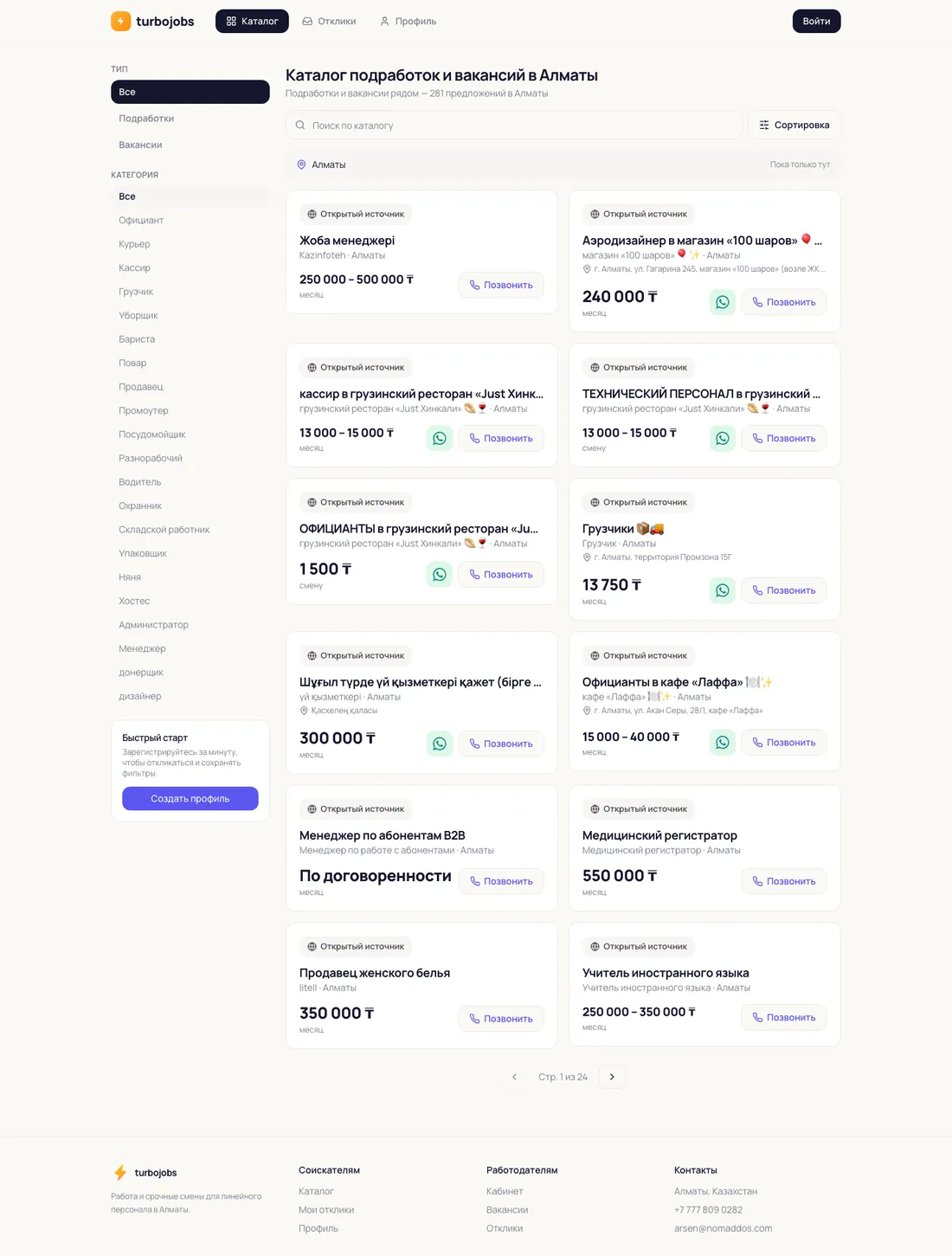
TurboJobs
A service for finding part-time work and jobs for frontline staff. A catalog with type and category filters, one-click response by call or WhatsApp, dashboards for candidates and employers.
Открыть turbojobs.app ↗Not a brochure site but a working product: user dashboards, admin panels, marketplaces, internal systems. We start with an MVP — the smallest version you can put in front of users to test demand — and grow it on data rather than guesswork.
The best proof that we can build products is the ones we launched and run for ourselves. Here we pay for architectural mistakes out of our own pocket, so we know their price in advance.
A service for finding part-time work and jobs for frontline staff. A catalog with type and category filters, one-click response by call or WhatsApp, dashboards for candidates and employers.
Открыть turbojobs.app ↗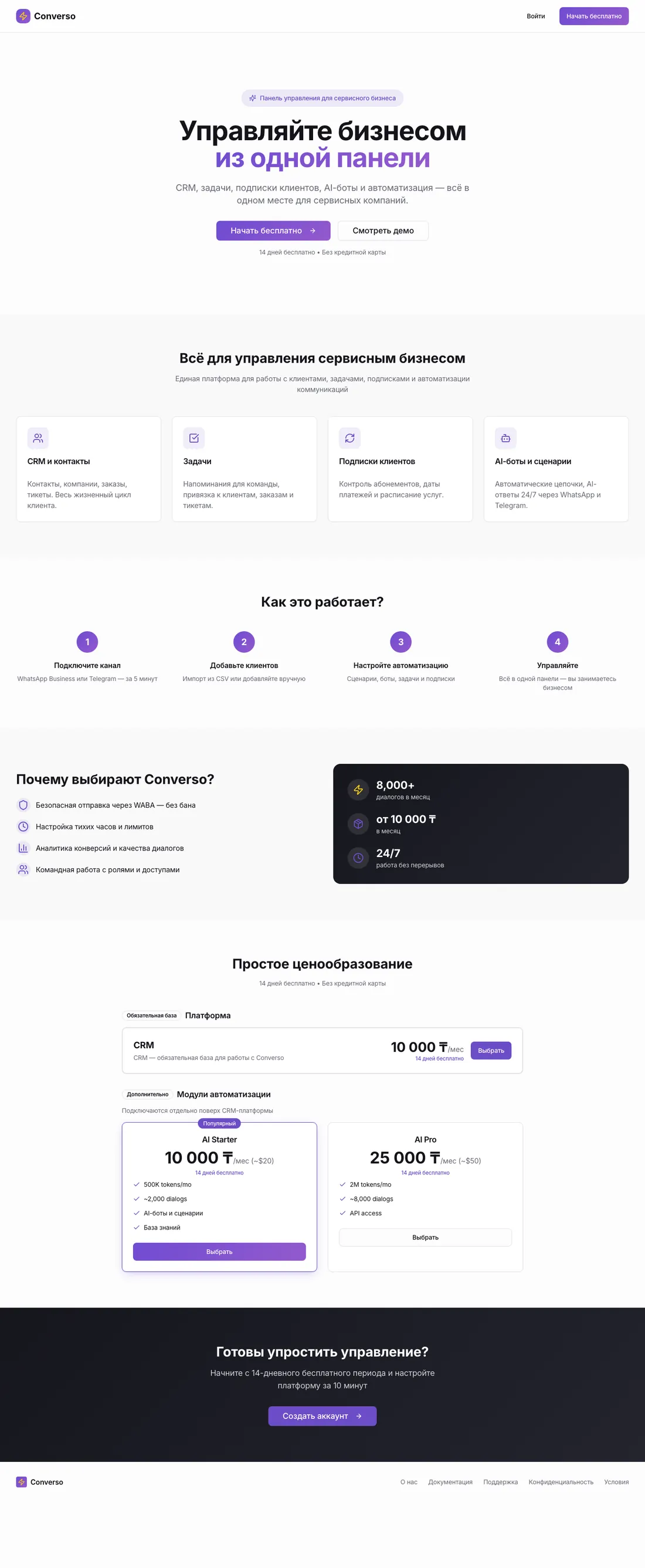
An admin panel for service businesses: CRM and contacts, tasks, customer subscriptions, AI bots and scenarios for WhatsApp and Telegram. With plans, billing and access levels.
Открыть conversochat.lovable.app ↗An MVP is the smallest working version of a product you can already put in front of users and charge for. Not a Figma prototype and not a deck, but a live service with a narrow feature set.
The point is to test the main hypothesis before you spend a yearly budget. Usually one scenario is enough: sign up — perform the key action — pay. Everything else waits for data.
Timeline — 6-8 weeks with a clear idea and your involvement in reviews. We show the first clickable screens in week two or three so you can correct direction along the way.
SaaS differs from a regular service in that you sell access by subscription rather than once. Hence requirements a website never has: pricing plans, plan limits, renewal and cancellation, invoices for companies, separate workspaces for different clients.
We design the architecture for multiple companies in one system from the start: each has its own data, users and settings, while an update ships once for everyone. Retrofitting this later costs more than building it in.
Payments are wired the way Kazakhstan expects: Kaspi, bank acquiring, company invoices with closing documents.
More often than not a product starts with the internal part rather than the public one. A customer dashboard showing orders, statuses and documents. An admin panel where your team runs all of it without calling a developer. A portal for dealers or partners where each sees their own prices.
Such systems are rarely needed «like everyone else's» — they mirror your processes, which is why off-the-shelf solutions fit them badly.
An off-the-shelf CRM covers typical sales. But if you have a long deal cycle, non-standard stages, calculations by your own formula or accounting that no ready system has, building your own is cheaper than paying for years of customising someone else's.
We will tell you honestly when custom development is not needed: if the task fits amoCRM or Bitrix24, the right move is to configure those and save your money. Custom makes sense where ready-made genuinely does not fit.
We work in sprints: short cycles, each ending with a working version you can look at. We do not disappear for two months only to present a «finished product» that turned out to be the wrong one.
After launch we stay for support: fixes, monitoring, improvements driven by analytics. Priorities come from how people actually use the product, not from guesswork.
The code and all access belong to you. We hand over the repository and document deployment — you are not locked to us and can continue with any team.
No forty-slide decks. A twenty-minute call, a quote in writing, the decision is yours.